
AI Standards and Principles
Responsible AI, built for end-of-life care
At Curantis Solutions, we believe artificial intelligence should make healthcare more human, not less. Our responsibility is to ensure AI supports clinicians, protects patient trust, and operates with transparency and accountability. Curantis AI is designed as assistive technology with clear human oversight, strong governance, and healthcare-grade security. As standards and regulations evolve, we remain committed to responsible innovation that serves providers, patients, and families first.
Human-first
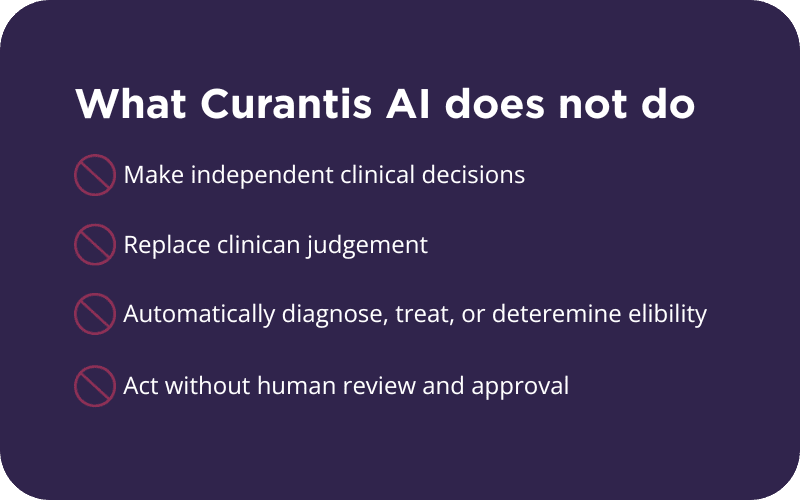
Decisions remain with clinicians and staff. AI informs the work; people make the call.
Assistive, not autonomous
AI supports workflows through drafts, summaries, and insights. It never acts on its own.
Accountable and practical
AI must deliver real value while meeting healthcare-grade privacy, security, and compliance standards.
Our Philosophy
AI that reduces burden while preserving clinical discernment
Curantis uses artificial intelligence to reduce administrative burden, improve consistency, and support hospice and palliative care teams. Our AI capabilities are designed to assist people, not replace clinical judgment. That principle shapes every capability we build and every safeguard we put around it.
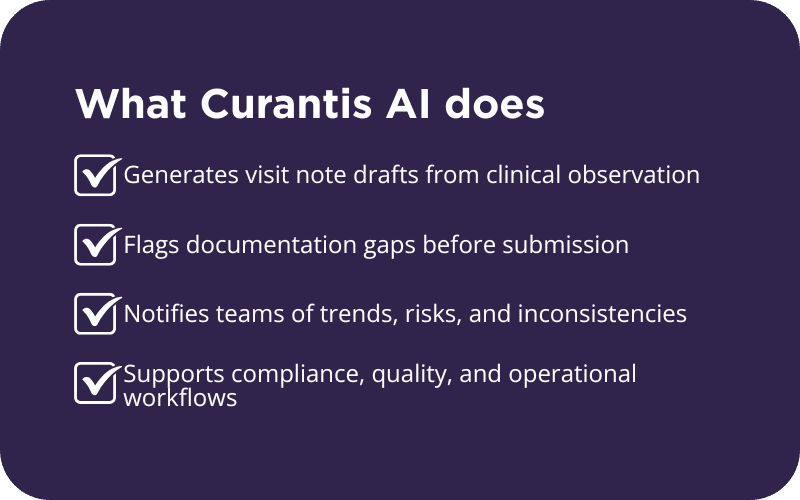
Governance & Commitment
Responsible AI governance
Curantis maintains internal AI governance to evaluate risk, oversee deployment, and monitor performance. AI features are reviewed prior to release and continuously monitored after deployment, with the ability to modify or pause functionality if risks are identified.
Our AI practices align with the NIST AI Risk Management Framework (AI RMF), emphasizing transparency, human oversight, ongoing monitoring, and continuous improvement. All AI capabilities follow the same HIPAA, security, and access controls as the Curantis software.
Customer data is protected and never used to train public or third-party AI models without explicit agreement. Curantis is committed to responsible AI that strengthens care delivery, supports compliance, and respects the trust of providers, patients, and families.
NIST AI RMF
Transparency, human oversight, and continuous improvement.
HIPAA
The same privacy and security controls as the Curantis software.
ONC CHPL-listed
A certified health IT platform meeting federal standards.
Human-in-the-loop
Every AI output requires human review and approval.
AI Governance FAQ
Questions providers and buyers ask us
Clear answers on how Curantis governs, secures, and oversees AI across our Hospice and Palliative Care Software Solutions.
What framework guides your AI governance?
Curantis recognizes that AI regulation in healthcare continues to evolve. In the absence of a single governing statute, we align our AI practices with established and emerging standards, including the NIST AI Risk Management Framework, HIPAA privacy and security requirements, and healthcare software governance best practices. AI capabilities are evaluated for clinical, operational, privacy, and compliance impact prior to release and monitored continuously thereafter. This approach ensures Curantis AI:
- Supports CMS documentation and compliance expectations
- Aligns with accreditation and quality frameworks
- Meets enterprise buyer governance requirements
- Remains adaptable as federal and state AI policy matures
Is Curantis AI autonomous?
No. All AI output requires human review and approval.
Is PHI used to train AI models?
Curantis uses dedicated AI infrastructure for processing clinical data. While our AI capabilities may leverage third-party model providers, all processing occurs within our HIPAA-compliant environment with BAAs in place. Customer data is not shared with, retained by, or used to train public models.
Can AI features be disabled?
Yes. AI functionality can be adjusted, paused, or disabled if risk or customer preference requires it.
How is AI output audited or traced?
AI-generated content is logged and attributable, supporting internal review, quality assurance, and compliance workflows.
Does Curantis AI generate final clinical documentation?
No. AI assists with drafting and organizing information, but all documentation must be reviewed, edited, and finalized by clinicians.
How does AI impact survey readiness?
AI supports documentation completeness and consistency while preserving clinician accountability, helping agencies remain survey-ready.
How does ONC CHPL listing relate to responsible AI use?
Curantis is ONC CHPL-listed, meaning our AI operates within a certified health IT platform that meets federal standards for security, auditability, role-based access, and clinical safety. This provides a strong foundation for responsible AI, while AI-specific governance and oversight are applied separately.
What happens if regulations change?
Curantis designs AI governance to remain adaptable as CMS, state, and federal guidance evolves.


See responsible AI at work
Curantis AI lightens administrative burden and improves accuracy so your team can focus on what matters most: patient care.